Xian-Jie Yang Laboratory
Retinal Development and Gene Therapy
Uncovering the mechanisms of retinal development and finding new therapeutic approaches

Xian-Jie Yang, Ph.D.
Professor
- Dolly Green Chair in Vision Science
- Department of Ophthalmology
- Director, Molecular Biology and Gene Delivery Core
- Jules Stein Eye Institute
Regulatory Mechanisms Involved in Retinal Development and Repair
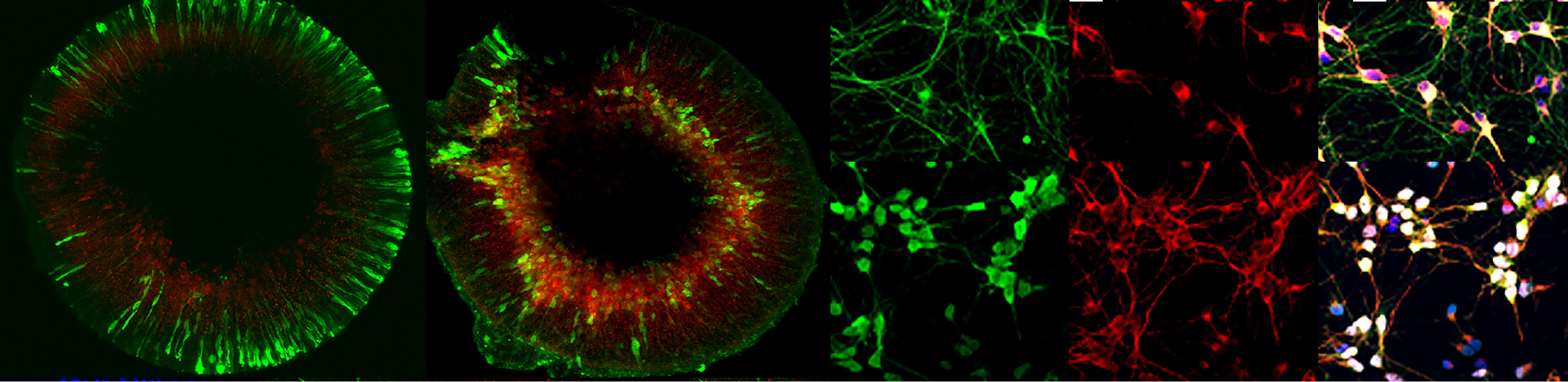
Research of the Yang laboratory aims at understanding mechanisms regulating retinal development and maintenance. We study how intrinsic cell signaling events influence progenitor cell proliferation and neuronal fate commitment during retinal neurogenesis, and how exogenously applied growth factors affect neuronal survival under disease conditions. We also use human pluripotent stem cell-derived retinal organoids and neurons to establish disease models for inherited optic neuropathy and to facilitate treatment development.
I. We are using molecular genetic approaches to addresses mechanisms of neuroprotection:
- Which cellular metabolic pathways contribute to neuronal maintenance?
- How does retinal degeneration alter mitochondrial morphology and function?
- What cellular signaling events are triggered by trophic factors to enhance neuronal viability?
- How to elicit retinal intrinsic neuroprotective potential?
Outcomes of the research will provide much needed insight for ongoing clinical trials aimed at treating retinal degenerative diseases.
II. We are using stem cell technology and virus-mediated gene delivery to study human retinal development, elucidate disease mechanism of inherited optic neuropathy, and develop effective therapies:
- How does neurogenic transcription factors regulate early retinal neuronal fates?
- Does mitochondrial deficiency affect human retinogenesis?
- What are the disease phenotypes of optic neuropathy in stem cell-based models?
- Can viral vector-mediated gene therapy or metabolic modulation attenuate inherited retinal degeneration?
These studies will provide more efficient methodology to produce human retinal neurons and new knowledge regarding human retinal development. Furthermore, stem cell-based human optic neuropathy disease models will be a valuable testing platform to evaluate the efficacy of novel treatment strategy prior to clinical trials.
Lab Members



Undergraduate Students

Jinghan(Frank) Huang(he/him)
Undergraduate Student
Frank studies how OPA1 mutations disrupt retinal ganglion cell function in dominant optic atrophy. His work focuses on how the membrane properties of these cells shift under the metabolic stress such mutations impose, which connects to his collaborative investigation of potassium channel dysfunction at the Barnes Lab. He is pursuing an MD/PhD with a focus on vision neuroscience and neuro-ophthalmology.

Paria Jahadi(She/her)
Undergraduate
Paria conducts genotyping, cryosectioning, eye-cup dissections, and immunostaining.

Alison Oak(she/her)
Undergraduate
Alison is currently working on a project that studies the functionality of rods in OPA1 knowckout heterozygous and homozygous mice. Alison will also take to studing the morphology of the mitochondria in the OPA1 affected rods. Alison is extremely interested in learning about the structure and functions of the eye and is enthusaiticly contributing to the greater goal of finding solutions for RDS and diseases such as glaucoma. Alison is also very interested in the field of opthamology and finds what the Yang Lab is doing essential in helping cure eye disease.
Adeline Peterson(She/her)
Undergraduate
Adeline is currently using genetic analysis to study how metabolism affects retina neuronal survival and function, particularly in OPA1 mutations. She is interested in learning how gene editing can be used to understand and treat neural disorders.

Uma Ram(she/her)
Undergraduate
Uma is currently working on a project studying Dominant Optic Atrophy (DOA) and retinal degeneration, with a focus on photoreceptors and retinal ganglion cells (RGCs). Using mouse models, she contributes to research investigating gene therapy approaches aimed at preserving retinal cell function and survival. In addition to research, she helps train new students in lab techniques.
Marie Sedrak
Undergraduate
As an undergraduate volunteer, Marie will contribute to research that investigates the relationship between metabolism and the survival and function of retinal neurons. She is particularly interested in retinal disease and degeneration and will participate in genetic analysis using mouse models to explore the processes that impact retinal health.
Recent Publications
Derivation and Characterization of Isogenic OPA1 Mutant and Control Human Pluripotent Stem Cell Lines
Katherine A. Pohl, Xiangmei Zhang, Johnny Jeonghyun Ji, Linsey Stiles, Alfredo A. Sadun, Xian-Jie Yang
Cells (2025)
View Publication